If you’d like to jump to specific musical sections: the Main Menu begins around 1:15; Phase 1 (synth horror score) starts at 3:18; Phase 2 (1950s-inspired horror style) begins at 5:32; Phase 3 (Elfman-esque frenetic orchestral style) starts at 7:00; the Win music appears at 8:51; and the Loss music begins at 9:47.
To hear the custom pause-menu smear effect, examples begin around 5:26.
The link below contains a detailed write-up, created in addition to the capstone requirements, that explains the Harmonic Hierarchies framework, its application within this project, and the resulting conclusions.
Dave Maynard ‘Harmonic Hierarchies’ [PDF]
The link below contains a sample PDF score for the Main Menu music. I provide fully notated written scores for over 95% of my compositions, all of which are available upon request.
Complete Game re-architected
Berklee BA: Capstone Project
Unity (Wwise)
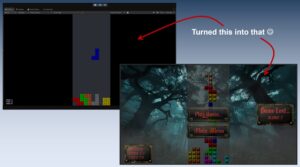
This project began as the default Berklee Tetris framework and was completely re-imagined, rebuilt, and expanded into a fully original, horror-themed interactive experience. I fixed and replaced core UI functionality, implemented new interactive systems, and redesigned the game from the ground up to support adaptive audio and a cohesive aesthetic identity.
Visually, every graphic asset was replaced to support a darker, atmospheric tone. I created a modular fog system that dynamically enhances depth, motion, and mood during gameplay, helping transform a familiar puzzle game into something uncanny and expressive. The result is a “spooky Tetris” that feels intentional rather than gimmicky, familiar mechanics filtered through a horror lens.
Musically, by design, the game pays homage to multiple horror traditions. The main menu introduces players with a slightly creepy, woodsy dance, setting an off-kilter tone from the first moment. Win and loss states each have distinct stylistic treatments, reinforcing emotional outcomes rather than relying on generic stingers. The core gameplay is scored across three fully realized horror styles:
-
A synth-driven horror score, emphasizing tension, pulse, and modern genre tropes
-
A 1950s-inspired horror score, referencing classic film language and orchestration (featuring the Theremin)
-
A frenetic, ‘Elfman-esque’ orchestral score, pushing speed, energy, and manic motion
Each style is treated as its own musical world while remaining structurally compatible with the gameplay systems beneath it.
Harmonic Hierarchies (HH)
At the heart of the project is my Harmonic Hierarchies system, a compositional framework I designed specifically for adaptive music. HH organizes harmony, texture, orchestration, and intensity into structured layers that can shift fluidly without breaking musical continuity.
In this project, Harmonic Hierarchies proved highly effective at maintaining stylistic coherence under constant change. As gameplay intensity increases, layers transition naturally rather than abruptly, preserving musical intent while supporting realtime interactivity. The system demonstrated that complex harmonic language can remain expressive, readable, and emotionally grounded even in a highly adaptive environment.
Video 1 – Audio & Wwise Implementation
The first video focuses exclusively on the audio implementation. It begins with the Wwise setup for sound effects and UI interactions, then walks through each musical composition in full, showing how they evolve through at least one complete adaptive iteration. This video highlights how the music is structured, layered, and controlled inside Wwise, independent of gameplay visuals.
Video 2 – Full Gameplay Playthrough
The second video presents a complete Unity playthrough with the full Wwise soundbank integrated. It showcases all gameplay options, adaptive music behavior in real time, and my custom pause-menu audio effect, where the entire mix slows and smears as if the “toy breaks” when time is stopped, then smears back into place when gameplay resumes. This effect reinforces the game’s surreal tone while remaining musically and technically controlled.
To skip ahead to the gameplay, jump to around 4:38.
Complete Game re-architected
Unity (FMOD)
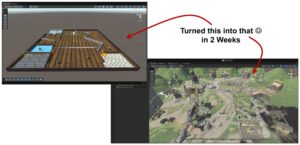
This was the final project for the Game Audio course at Berklee. While the assignment itself was only a 2–3 week project at the end of the course, I chose to use that limited time to completely redo everything: the level design, graphics, UI, and code, while also adding a number of new audio features. As required, all sound effects and the original score were created from scratch as well.
I leaned into a comedic, 1950s-style horror theme, imagining a literal flying saucer abducting cows in medieval times while searching for their human friend by the end of the game. Despite the tight schedule, I fully re-architected the project while still adhering to the constraints of the coursework.
The link below is a detailed PDF outlining the work completed for this project. It covers the sound effects, music, and FMOD implementation, while also highlighting the additional software engineering required to fully re-architect the project.
Note: If you’d like to skip ahead, Intensity 1 begins fairly early in the video. Intensity 2 is best viewed starting around 1:30, the custom-coded Pause Menu effects filtering appears at approximately 2:00, and Intensity 3 begins around 2:18.
Note: Several sound effects are intentionally omitted in all of these clips to keep the focus on the composition and interactive music techniques being demonstrated. Any UI sounds that are present were created by me; however, the music itself is the primary focus of these examples.
Adaptive Music – Sci-Fi Action
Unity (Wwise)
This is a hybrid synth score driven by a wide palette of synthesizers, punchy drums, and electric guitar and bass. It is a fully reworked Berklee project assignment; the original project contained multiple logic issues. As both a composer and having multiple decades of experience as a software engineer (including Unity), I was compelled to resolve the underlying problems and extend the project with new technical capabilities.
Three demonstration videos are included. The first showcases the main menu music, implemented in Wwise with extensive randomization across both melodic content and instrumentation layers. This approach allows even simple harmonic material to loop for long durations without tiring the ear, yielding 945 unique phrase playthroughs.
The second video focuses on gameplay music, built as a layered system with three escalating intensity levels, preceded by a looping “intensity zero” intro layer. These layers are driven by game logic, (custom logic that was repaired and refined), to respond dynamically to successful gameplay progression. Each intensity level features its own randomized layering: intensity one supports 192 variations, intensity two 504 variations, and intensity three 936 variations. A custom filter is also demonstrated, illustrating how the pause menu can directly influence the musical state.
The third video presents the win and loss music, each implemented with multiple randomized instrumentation options to maintain variation across repeated playthroughs.
This content is intended solely to demonstrate original musical composition. No affiliation, endorsement, or association is claimed or implied with the VR game Alien: Rogue Incursion, its intellectual property holders, developers, or publishers.
Layered Music – Sci-Fi Action
Unity (Native)
This is a hybrid synth score built around several layered synthesizers, complemented by orchestral VST elements, most notably a cello, and, as the third layer, an industrial heavy-metal combat texture.
The piece is a completely reworked Berklee assignment; the original version used placeholder visual assets and contained several technical issues, most notably reverb-tail bugs, all of which have been fully resolved here.
The goal of the project was to create three distinct intensity levels, (exploration, oncoming danger, and combat), implemented as three tracks that loop seamlessly within Unity. These tracks are driven by programmatic triggers that dynamically elevate or de-escalate tension, as demonstrated in the embedded Unity video player.
This content is intended solely to demonstrate original musical composition. No affiliation, endorsement, or association is claimed or implied with the game Hades II, its intellectual property holders, developers, or publishers.
Branching Music – Fantasy Action
Unity (Native)
This piece is a hybrid synth score built around layered synthesizers and electric guitar, blended with orchestral VST elements, most notably a cello, and capped by an industrial heavy-metal combat layer.
This is a fully reimagined Berklee assignment; the original implementation relied on placeholder primitive visuals and contained several logic issues, all of which have been resolved in this version.
The project was designed to support three distinct gameplay branches within a single game space: a safe “home” environment, a transitional breakpoint where the player enters a mysterious shop, and high-energy combat. Each location-based track loops seamlessly and contains four internal sub-phrases that play in a randomized, shuffled order to maintain variation.
For demonstration, all transition changes are handled natively within Unity via programmatic triggers, as shown in the embedded Unity video player.
SFX & Music – Sci-Fi
FMOD (No game)
This is a sound-design and music-composition project built entirely in FMOD, with no associated game. The concept centers on a sci-fi cargo spacecraft, featuring a wide range of interactive sound effects including, but not limited to, onboard computer systems, engine states, and load-balancing mechanics. These elements are paired with a layered musical score designed to respond dynamically to rising tension, most notably within a pursuit or chase scenario.
All interactive sound behaviors and musical state changes are demonstrated in the accompanying video, with transitions driven by FMOD events, parameters, and logic-based triggers.
This content is intended solely to demonstrate original musical composition. No affiliation, endorsement, or association is claimed or implied with the game New World, its intellectual property holders, developers, or publishers.
Layered Music – MMO
FMOD (No game)
This project demonstrates layered music techniques designed to support rising tension, moving seamlessly from calm exploration to heightened danger and full combat, while remaining within a single musical scope and arrangement, implemented in FMOD. The concept mirrors the persistent “area theme” approach common in MMOs, where the music continuously adapts to escalating threat levels and, when necessary, combat intensity.
There is no original game associated with this project; for visual demonstration purposes only, a timed gameplay snippet from the MMO New World is used.
The score was intentionally written to be slightly “over the top,” leaning into heroic thematic development and bold orchestration.